How to Share Metrics with a VC

Data_spreadsheet_Flickr_Jorge_Franganillo.jpg_resized_460_We see about 1000 pitches every year.  That's about 20 per week.  With the majority of these, we know that it's not for us within the first 15 minutes.  We do engage further with about 400 startups every year.

The first engagement is either an in-person meeting or a call.  This is the step where we start to demand metrics and data from these startups, and frequently, it's a painful process.

What we typically like to see is three sets of information:

1. Historic financials

Here, I don't necessarily mean the  statutory income statment, but sometimes, they work as well, as long as they reflect the management's view of the company's operations.  What we look to see is a summary of the monthly economic activity or the business, and perhaps, the unit economics.  Typical items we looks for are:

  • The Top-Line Figures (GMV, Gross Revenues, etc.)
  • Cost of Goods Sold
  • Gross Margins
  • Operating Expenses (Salaries by function, Marketing Expenses, G&A, etc.)
  • EBITDA

We prefer seeing these in your local currency, monthly, and broken down to its natural components, that tell the story of your business.

2. Forecasts

In your forecasts spreadsheets, we like to see both a top down and a bottom up approach, to make sure they support each other.  By top down, I mean starting with the total addressable market data, and narrowing to get a sense of what size a slice you'll ultimately have of that market.  By bottom up, I mean checking your growth projections agains the historic patterns. Ideally these numbers are broken down monthly.  If you are foreseeing any jumps, we like to discuss why.

 3. Other Key Metrics

The third spreadsheet we like to see is your non-income statement metrics.  These give us the best sense of how you see your business.  Essentially, this is theKPI dashboard you look at to manage your business.  It may include data on your traffic, level of engagement, the number of suppliers, salesperson productivity or hours of content, etc.

One set of metrics we find useful in almost all types of businesses is customer data.  Whether you are an enterprise or a consumer business, the most valuable assets of most startups are their customers.  Therefore, demonstrating to us how your customers behave once you acquire them, using data, is critical.  Tools like cohort analysis allow us to have productive discussions with you about your business.

I'd urge any startup talking to VCs in iterating and refining these three sets of information before proceeding too far in their conversations.  Not only will it keep the process with VCs more efficient, it will improve your understanding of your business.

The Game has Changed – Power to the Audience

Adblock_logo_&_wordmarkNow that Apple is openly encouraging ad blockers, publishers are up in arms.  The topic dominated the tech conversation last week, and I think it is well understood by now. If you are not up to speed on it, here are a few links to skim.

This development should not be a surprise to anyone in digital media.  We have been headed in this direction for a while. When was the last time you persevered through a Youtube pre-roll's full length?  How about clicking on a display ad?

Apple's move is understandable.  While spammy ads are a nuisance on the desktop experience, they are a killer when you deal with them on the small smartphone screens.  Apple wants its users happy in their browsing experience, and does not have to apologise to anyone when you decide to use blockers.

Ultimately the media audience is gaining power, and it will reward not those that are trying to circumvent and trick the distribution channels, but those that are committed to delivering engagement.

A good recent example is Medium, which has grabbed the headlines with its recent round.  It is delivering real engagement and thus proving valuable to the brands that are using it to deliver their messages – in context and without spam.

The bar is now higher for monetisation for publishers.

VC Fund Economics

Ss-moneyIf you are an entrepreneur looking to raise capital from VCs, it's important to understand VC economics.  This understanding will save you time and effort by helping you identify the right VCs to target and how to frame your conversations with them.

For a successful early-stage VC, the minimum expectation seems to be that in a portfolio of 20 investments, one or two most successful investments will return the fund, the next five will return it once more, and the remainder will return it yet one more time.  This gets you a 3X on your fund.  Of course, there are large variations on the distribution, but it's a good enough example to start with.

If you are a $50m+ fund, you can not assume each of your investments will return the fund (unless you are a top-tier shop in Silicon Valley).  But you do need to ensure that each one can at least return 30-40% of your fund, if things go well.  That way, if half of your portfolio goes well, you can count on a minimum of 3X.

Our fund is $150m, so we would typically like to see a $100m+ exit in each of our portfolio companies, if things go well. This math is usually behind our "no"s to founder teams, where we see a good business, but not enough size in market opportunity.


The Hockey Stick

As a VC you get pitched many hockey stick stories, but infrequently see an actual one.  This week, I came across one in the case of Airbnb (on TC).

Airbnb

This is the graph of summer bookings by travelers on Airbnb.  I assume there are several drivers to this growth:

  • A new market: Airbnb enables a behavior that was difficult to execute before it.  Similar to Uber, its growth benefited from the fact that it created its own market, rather than merely stealing market share from incumbents.
  • Mobile growth: As one of the earliest mobile-first companies, it was always one of the top apps in the travel category in each market it operates in.
  • Social graph: The business model requires a high-level of trust.  Airbnb used the social graph very effectively to provide this trust, and thus benefited from the  virality that social networks open up.
  • Global network effect: Travel is inherently a global market, so in each local market, the global network effect trumps the local one.

As a result, you get the beautiful shape we see above.

Migrating Digital Histories

Bigdata-1The web is aging.  I remember the day my co-founder at SelectMinds, Steve Richmond, first pointed me to the new search engine, Google, in 1999.  I also remember setting up my first Gmail account, this  blog on Typepad, my YemekSepeti account, all in 2005, my Facebook account in 2006, my Twitter account in 2007, my Runkeeper account in 2010, and my Uber account in 2012.  I have had little reason to switch from these services, and continue to use them still in 2015.  In the meanwhile, these services have learned about my preferences and patterns. 

Most of these services publish APIs that would allow me, or a service I'd permit, suck meaningful data out of them.  What is important for that service is that it knows the context of these services. Think of it as a Zapier or Unroll.me, not for connecting services to each other or unsubscribing, but for connecting them to me, so I can claim my ownership of my data growing in each of these services.  Ideally, such a service would then offer me a set of tools to manage this data, provide wizards for migrating between service providers.

I am surprised such a service is not here yet. I think it would be a valuable area to tackle.

PS. Of the services listed above, Typepad will likely be the first one I abandon. I'd appreciate a tip if you know of a good tool for migrating out of Typepad.

Changing Customer Behaviors Cut Both Ways

Hail cabTechnology educates.  Uber has taught millions of people to dip their hands in their pockets, as opposed to raising it up in the air, when they need a ride.  Booking.com has taught people to consider to the flexibility of their travel plans, when booking a hotel room.  They have influenced behavior, made things easier, and created a lot of value by gaining lots of customers.

On the supplier side, they  have become the platform of choice, primarily because they had aggregated the greatest slice of demand, in the shape of the customers mentioned above.  They then capitalized on their aggregated supply and demand, by commanding very high take rates (commissions) from the transactions they enable, leading to their unicorn status.  In the case of Uber,  a recent leak indicates that the take rate is ~20%, and at Booking.com, the take rate estimate is ~%16.

One question that comes to mind is whether these high take rates will survive? The pressure is on the platform, especially as it grows, allowing it to benefit from economies of scale, and as competition emerges, to lower its take rate.  We have seen this in numerous marketplace businesses in our portfolio.  In addition, the education process I describe above, is also benefiting the incumbents who are utilizing these platforms to reach customers.  A case in point is the case of Hilton's own booking app.  According to the NY Times: 

Hilton has introduced a number of services for guests who book directly, including a digital check-in option that eliminates waiting in line. Quickly adopted by its customers, the app is now used by over one million people each month, according to Geraldine Calpin, who oversees Hilton’s worldwide digital efforts.

A million people each month is a huge number, and should be an alarm for Booking.com.  A company called Arrow will soon make NY yellow cabs as easily hail-able as Uber cabs.  Technology, while educating users on more efficient new behaviors, is also lowering the cost of incumbents to battle marketplaces.

My prediction is that marketplaces will ultimately earn their permanent place in their respective markets (note the pun :)), but I would not count on the high take rates to continue.


Stop Spamming Me from your Service Domain

SpamI am your customer, perhaps a happy and loyal one.  Therefore, I pay attention to your emails – I may have placed an order on your service, or may be expecting to hear from you.

So I open your emails, especially if they come from the same email domain as your service's notifications do.  If many of those emails are unsolicited and irrelevant ads and promotions, you are abusing my loyalty.

Stop taking advantage of the attention of your valuable customers.

As an aside, there is a business opportunity to figure out how to separate service notifications from promotions.  Gmail does not seem to do a good job at this.

Momentum Plays a Large Role in VC Dynamics

Newtons_cradle_animation_book_2We recently passed on an investment opportunity.  What would probably be a surprise for the founders is that we were actually quite keen to invest a few weeks earlier.  But the opportunity lost momentum for us.

A VC fund constantly evaluates investment opportunities, not just on their absolute merits but also on a relative basis.  Since we have limited capital and limited bandwidth, we try to recalibrate our opportunity pipeline on a continued basis.  This may naturally lead to a shift in priorities.

Today, the VC market may feel like a seller's market.  However, my advice to founders is that when you find a term sheet in front of you, focus on keeping the momentum in the process.  You may meet lawyers who are trying to show you what sharp negotiators they are.  Coach them to keep their eyes on the finish line. 

Remember, as a startup founder, you have one objective: maximizing the probability of success for your venture.  Funding is a big factor in this equation.  So, when you have capital in your sight, don't take your eyes off of it. 


The First “Turkish Unicorn”

YsOne of the most frequent questions we got when we were raising our Turkey & CEE-focused VC fund at Earlybird, was about the small number of large exits in the region, especially in Turkey.  Our thesis was that the problem was on the supply side – not enough large startups were being built.  We contended that the market was large, and part of the problem, to which we were bringing the solution, was the lack of local funding.

Today, we have the great news that YemekSepeti has been acquired by Delivery Hero for $589m, which makes it the first Turkish internet startup exit above 1 billion TL (TL 1,596,000,000) to be precise.  I have known the company since 2008, and saw it develop into one of the healthiest marketplace businesses I have ever seen in the world.

Congratulations and heartfelt thanks to Nevzat, Melih and the rest of the team that made it happen.  Your story will become a beacon for many more talented young entrepreneurs.  Well deserved!

Marketplace Insights via Etsy

Etsy-logo

Chicago VC Ezra Galston has a good analysis of the Etsy S1 on Techcrunch today.  We are investors in many marketplace businesses (YemekSepeti, VivenseGrupanya, Idemama, Tapu.com, Videdressing, Auctionata, Carpooling, Smava, etc.), and we watch the industry intently, as there has been more recent value created in marketplaces than any area of consumer internet.

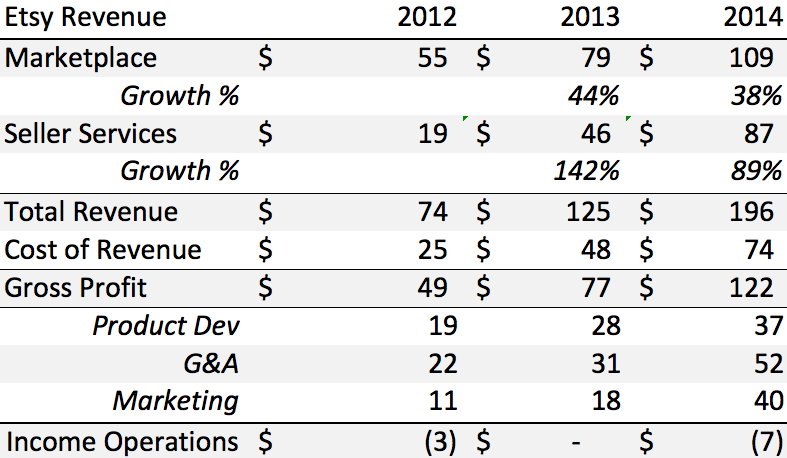
Galston's post is worth reading in full, so I will not try to summarize, except for one very interesting data point: that almost 45% of its revenue comes from Seller Services, compared to ~25% just two years ago.

Etsy10

This means that the growth of the marketplace is going to be more dependent on the number of sellers, than the transaction volume.  At first look, this does not look too intelligent: the latter number will certainly grow faster.  However, as we see marketplaces maturing, this is the way that the leader/incumbent can take aggressive pricing moves to keep competitors away.  This is observable in Etsy's commissions moving from 5+% to 3.5%.  If you are an emerging Etsy competitor, there's not enough margin for you to grow fast.

Ultimately, this can lead to marketplace deflation, a la CraigsList, which came and killed many fledgling classifieds sites with its massive traffic and free offering.  I am curious to see if we start seeing this type of defensive behavior from the modern marketplace champions, such as, Uber and Airbnb.