Sometimes it's great to be reminded of how little we really need. The rest is all wants.
Category Archives: Genel
Apple Magic Mouse
I rarely post about hardware but this feels like a breakthrough in UI. I assume the apple tablet will incorporate similar capabilities.
LHC Sabotaged by its Future

There's a growing meme around the idea that:
.. the troubled collider (MCS: The Large Hadron Collider) is being sabotaged by its own
future. A pair of otherwise distinguished physicists have suggested
that the hypothesized Higgs boson, which physicists hope to produce
with the collider, might be so abhorrent to nature that its creation
would ripple backward through time and stop the collider before it
could make one, like a time traveler who goes back in time to kill his
grandfather.
It's really fun to think about. 🙂
Questioning Healthcare Capitalism
Umair is yet again making me think. This time about the US decision to rapidly deregulate healthcare in the 1980s. The results, summarized by the following two charts, seem to be pathetic.
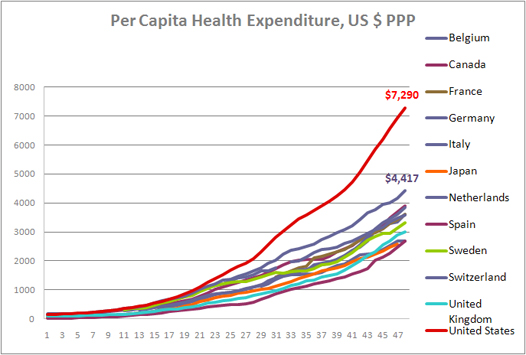

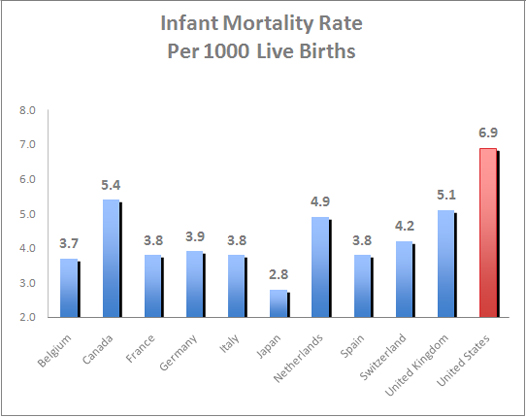
Thşs path does not seem sustainable. The US healthcare sector will have to shift courses. Will it be able to? Umair suggests the following. I am not sure if this is the prescription but it seems like a step on the way.
Here are seven priorities for 21st century healthcare institutions.
I've found that a simple "Six W's" framework can be a powerful tool for
igniting institutional innovation. Let's use it to reconceive a
healthcare industry built to create thick value: authentic, meaningful,
sustainable value.Why is payment made? For better, fairer health outcomes, not prescriptions.
What is paid for? Micro-scale services, not "product."
When is payment made? After better health outcomes have been realized.
Which uses is payment put to? Innovation investment significantly outstripping marketing expenditure.
Where is payment made? Directly to those who provide services (aka, doctors) at the local level.
How is payment monitored, enforced, and negotiated? Through local, personal connections, not anonymous, impersonal transactions.
In what way are resource allocation decisions made?
Jointly, locally, and participatively, through ubiquitous, publicly
accessible information about products and services.
The constructive capitalism meme that Umair has been cultivating resonates quite a bit with me. I like his idea of thick value and recognize the possibility that striving for thick value may (will) create a new kind of economic structure for the 21st century. However, some areas such as energy, automotive and healthcare are starting off at such a disadvantaged position that the effort to shift courses will have to be immense.
Alain de Botton on Careers
TED calls it success and failure, but this is so closely tied to one's career than any other area. IT's worth watching.
Typepad Regrets
I stared blogging in May 2005. This is my 445th blog post. I blog about my work, early stage internet VC investments, and from time to time, my interests, including art, literature and current affairs. SortiPreneur is not a widely-read blog. I have found out that person-focused blogging is not a high-traffic proposition, unless the person you're focusing on is already well known. In my case, the focus is me, and I am no celebrity.
Back in 2005, I chose TypePad as my blogging platform. I am a paying user, paying $14.95/month, since May 2005, which means I have paid over $700 to TypePad so far. I also neglected to set up my blog in a specific domain, such as Sortipreneur.com or Sertoglu.com. Instead, I blog at csertoglu.typepad.com. I now hesitate to change that due to search engine related concerns. I initially chose TypePad because my blogging inspiration Fred Wilson was blogging on TypePad.
I now regret this choice. A few weeks ago my U.S. issued credit card was canceled due to some fraudulent activity at a merchant I had patronized. This cancellation kept me without that specific card for a few days, during which TypePad tried charging that card and failed. A few days later, my account was frozen. I could not post to or edit my blog. When I received my new credit card, for some reason, it was still getting declined. Also, strangely, my otherwise functioning Turkish credit cards were also being denied by TypePad, I could not blog for over 2 weeks!
If I were starting to blog today, I'd probably go with WordPress and host my blog on my own domain. I may still opt for that, like Fred did a few months ago.
R.I.P.: J.G. Ballard
One of my favorite authors has passed away. I recently finished Super-Cannes, and reminded myself what a master Ballard was in creating moods and ambiance.
News of deaths of talented people leave me with a sense of emptiness.
Don’t Launch? Counter-intuitive Advice from Eric Ries and Nivi
Eric Ries, the co-founder of IMVU, has a good post with some interesting and counterintuitive advice: Don't Launch! You should read the entire article but his primary objections to launches are:
- A marketing launch establishes your positioning.
If you don't know what the right positioning is for your company, do
not launch.
…. - When you launch
with the wrong positioning, you have to spend extra effort and money
later cleaning it up.
…. - Of
course, we didn't realize it was a blunder at all. We were actually
really proud of the positive coverage.
…. - You have to know your business model. Most
startups launch before they've figured out what business they're in.
…. - You
never get a second chance to launch. Unlike a lot of other startup
activities, PR is not one where you can try it, iterate, learn, and try
again. It's a one-way event, so you'd better get it right.
Nivi adds his take to the meme.
When I think about it, we never launched SelectMinds. Our PR effort began after we had our product and first few customers. Afterwards, it was introductions of new features or releases, but never a formal launch.
In contrast, we launched formally at Mondus. It was a difficult task since we did not necessarily have easy references to explain what Mondus was about. Then came Facebook and everything changed. However, the loud launch made the option of switching strategic direction a very tough one.
So, I think Eric makes a great point.
Audi A4 Manufacturing Process
Came across this at Signal vs. Noise and thought it was great:
Roubini is an Istanbulite!
(Or, should it be Istanbulian? Istanbuli?)
Just read in CN Portfolio that Nouriel Roubini was born in Istanbul and lived here until the age of five.
Not surprising in hindsight. I think I can detect the levantine cynic in him. The same is true for Nassem Taleb, who was born in Lebanon.
 Cem Sertoglu