Wisdom of Musical Crowds

This is really cool:

Bicycle Built For 2,000 is comprised of 2,088 voice recordings
collected via Amazon's Mechanical Turk web service. Workers were
prompted to listen to a short sound clip, then record themselves
imitating what they heard.

They should open source the audio tracks and see what others will make of it.

Is Twitter Threatening Facebook, or Vice Versa?

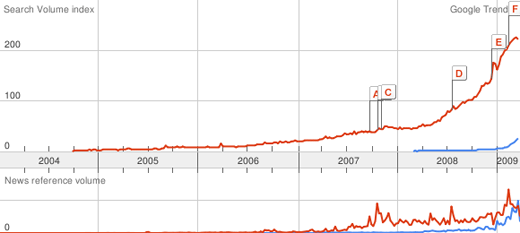
Anyone with a web presence can probably tell you that Twitter's growing extremely fast.  It's outpacing Facebook's growth in the same period, according to Nick O'Neill's analysis using Google Trends.  Here's the chart:

Twitter-facebook

However, I am not convinced that this is a fair comparison.

  • First of all, the early Facebook was not an open service. It required you to possess a dot-edu email address to register.  The comparison should be made to Twitter's college student user base.
  • Second, the price of admission to Facebook has always been considerable higher than Twitter.  A FB account without a full profile is less meaningful and severely limits the user experience.  Part of the cost of being a Facebook user is the profile completion effort.  Twitter does not have this barrier.
  • And finally, I attribute a part of Twitter's growth pace to the existing proliferation of social networks, including Facebook.  Facebook has been a catalyzer to Twitter.

 It's tempting to compare Twitter and Facebook.  However, I think it is as misplaced a comparison as the common Facebook / MySpace deathmatch.  Twitter is not a technology company.  It's a great feature, and I don't mean that dismissively, as I think you can build a great company with a feature.  Nevertheless, I'd be worried, if I ran Twitter, of its long term viability.  There will be only one owner of the social graph and the current favorite to win is Facebook.

Immigrant Entrepreneurship

My friend Aydin, in his new post, outlines his prescription for the ailing U.S. economy:  support for immigrant entrepreneurs.  He proposes:

Support the entrepreneurs, especially the immigrant ones. The stimulus
grants the government is handing out to different industries remains a
band-aid solution and basically just re-allocates existing resources.
Supporting the entrepreneurs, on the other hand, is likely to result in
new jobs, create *new* capital (ie new resources).

I have not researched the numbers on this but I strongly suspect that startups (not necessarily small lifestyle businesses, but high-impact entrepreneurial endeavors) are very efficient allocator of resources.  We felt this firsthand at SelectMinds, in the earlier stages, and created many jobs very rapidly as NYC climbed its way out of post-9/11 depression and the internet economy recovered from the dotcom crash.

Aydin also thinks startups founded by immigrants are critical to this phenomenon.  In that area, as he points out, there's quite a bit of impressive empirical evidence.  I have always believed that the U.S. is a net beneficiary of its progressive immigration policies (even though they can be improved).

I wonder if the same can be said about other countries.   I can not say I have seen examples of resourceful, enterprising endeavors by immigrants in Turkey.
Tweeting with Gods: Tweets as Haiku

Jeremy commented on my recent post and I thought I should elevate it to this blog's surface:

As
a poet and a writer, I have to agree with Joe on the idea of
constraints. Restrictions, parameters, forces of limitation: all of
these require us to do what we as humans do best: problem solve. Like
that lovely cliché, "necessity breeds invention": when confronted with
an obstacle, a constraint, we invent. And we could say the constraint
of 140 characters is as arbitrary as are the rules for writing Haiku.
Yet the latter remains popular, fruitful, and (when done well)
enlightening–after centuries. Does it replace the novel or the essay?
No, it cannot serve the same function. Likewise, no novel can approach
what Basho could in three short lines.

I suppose what I'm suggesting, really, is that like all hip content
these days, it's generated by the user, and it's the user who
determines quality. Just as I'm a better poet than I am a blogger or
tweeter, there'll be people who'll bring the best out of the 140
character form. And I think, what'll continue to define the life cycle
of the technology won't be whether there is portability or not, but
rather whether Twitter or its confederates (like ExecTweets) enhance
our ability to find those who, shall we say, Tweet with the Gods. Seems
like these days there are plenty of worthy practitioners in every
medium, but the media which survives does so on the basis that it's
deliverable to the right audiences, at the right time.

Who tweets with gods?  Do you have anyone you follow whose best is brought out by the 140-character limit?  Twitter haiku is fun and interesting.

In Need of Quotes and Easy-to-Swallow Bits of Wisdom

I was checking out ExecTweets, a new service by Federated Media and Microsoft that allows Twitter users to easily find and follow prominent business figures' TweetStreams.  Why would one want to do that?  When I look at who I follow on Twitter, it's mostly people I know and a few I don't but whose tweets I find either funny or interesting.  Twitter is very useful as a "status update" tool.  But I find efforts to say more through Twitter a bit forced.

Then I looked at sample tweets from the executives ExecTweets offers:

SteveCase Needless to say, an unsustainable trajectory. RT @boltyboy: US Health care costs 7% of GDP in 1970, 17% in 2009. http://tiny.pl/bnhc

zappos
"When a door of happiness closes, another opens. Often we look at the
closed door, we do not see the one that’s been opened." – Helen Keller

dwrasmus1
All times are times of uncertainty. We just notice it sometimes more
than others because something big shakes us from our complacency.

To me, it looks like the executive tweeters are broadcasting their thoughts and ideas in 140-character long bites.  Or, trying to…  Is this a usable format, or are we squeezing the ideas into the constraints of a soon-to-be obselete technology, the SMS?  Paul Graham broadcasts his ideas in thoughtful, edited essays.  Could I follow Paul Graham on twitter and understand his ideas?  I very much doubt it.

But quotes play an important role in communications.  They package ideas into more-easily-transportable packages.  The top quote sites enjoy (surprising to me) very high traffic numbers.

I wonder how the idea quality is effected by these new forms of packaging?

Minding Your Wallet: Mint & Prosper

When the overrwhelming topic is financial troubles, there are some who benefit.  It looks like CNBC is thriving despite Jon Stewart's attacks (which I find very funny, BTW).

Similarly, I was very impressed with Mint's numbers analyzed by SAI.  $8 – 10m in sales in 2009 is very solid.  Another company which should be thriving these days is Prosper.  Too bad that it has not been accepting new lenders since November. 

My former partner Steve Richmond is launching a new startup, GoalSpring, going after a similar opportunity.  There are opportunities in every market condition.

Don’t Launch? Counter-intuitive Advice from Eric Ries and Nivi

Eric Ries, the co-founder of IMVU, has a good post with some interesting and counterintuitive advice:  Don't Launch!  You should read the entire article but his primary objections to launches are:

  1. A marketing launch establishes your positioning.
    If you don't know what the right positioning is for your company, do
    not launch.
    ….
  2. When you launch
    with the wrong positioning, you have to spend extra effort and money
    later cleaning it up.
    ….
  3. Of
    course, we didn't realize it was a blunder at all. We were actually
    really proud of the positive coverage.
    ….
  4. You have to know your business model. Most
    startups launch before they've figured out what business they're in.
    ….
  5. You
    never get a second chance to launch. Unlike a lot of other startup
    activities, PR is not one where you can try it, iterate, learn, and try
    again. It's a one-way event, so you'd better get it right.

Nivi adds his take to the meme.

When I think about it, we never launched SelectMinds.  Our PR effort began after we had our product and first few customers.  Afterwards, it was introductions of new features or releases, but never a formal launch.

In contrast, we launched formally at Mondus.  It was a difficult task since we did not necessarily have easy references to explain what Mondus was about. Then came Facebook and everything changed.   However, the loud launch made the option of switching strategic direction a very tough one.

So, I think Eric makes a great point.

Modeling Social Media

I came across Nielsen's social media report titled "Global Faces and Networked Places" on Çağlar's blog, and had a chance to skim through it briefly.

It's a useful summary of the state of social media today.  However, it's trying too hard to retrospectively explain the success or failure of various social media properties  It delves into the reasons w-k-w is twice as popular as Facebook in Germany, or why Orkut has succeeded in Brazil rather than other properties.

Social media is an exceedingly complex phenomenon to model.  I think all hindsight attempts to explain the behavior of a large social network's participants are examples of us being fooled by randomness.  We crave patterns and invent them where they don't exist.

Nielsen falls in the same trap.

Facebook vs Google

Readers of this blog will know that I have been a Facebook bull since the botched Yahoo acquisition attempt.  I have iterated that I see Facebook as a technology company trying to own the indentity layer of the internet (AKA the social graph), and that I think it will succeed.  When it does, the $15b valuation Microsoft paid for its stake will look like a bargain.

Now comes the first serious analyst report (from RBC's Ross Sandler, via SAI) that bills Facebook as a threat to Google:

Facebook Could Surpass Google In 2011/2012: If we
assume modest deceleration in growth for both sites (an 85% CAGR for
Facebook and a 20% CAGR for Google), Facebook could surpass Google in
terms of total worldwide uniques, by late-2011 or early-2012.

The argument is based on an extrapolation of the traffic Facebook is sending Google's way, which is growing incredibly rapidly. See graph below, as well as the SAI link for further data.

I think there is a point.  Some will argue that the comparison of Facebook and Google is irrelevant and that one is a social media property while the other is a search engine.  I think it is relevant since the monetization path to both companies goes thorough attention.  Google is great at putting relevant messages in the attention span of the population.  Facebook is perhaps the only other company that can make a similar claim.

So, it's interesting to note the birth of the Facebook vs. Google meme.

Facebookgoogleuniques