Umair Proposes Massive Disincentives. I Agree.

Umair Haque, whose commentary I enjoy very much, has a ranting post in reaction to what he calls the continued looting of the society thorough tthe current bailout plans.  He's got a great point in the lack of disincentives in the current financial set up:

To make better bankers, we have to give bankers disincentives.
Disincentives might revolve around the idea of liability, for example.
Doctors face a personal liability because of the human costs they might
impose. Bankers could too, given the clear and clearly massive costs
they're imposing on the rest of us.

Here's another kind of disincentive of a much more radical kind:
auctioning trading seats. If we auctioned seats on the trading desks of
the big banks, the problem of adverse selection would magically go
poof. Why? Because the bid price of a seat would rise to match the
expected value of benefits from trading, counterbalancing those
benefits, and diluting the incentive to loot.

For example, NYSE seat prices rise and fall with equity values – and
it's no coincidence that the bulk of fraud and deceit happened at
banks, not on exchanges. Auctioning trading seats in general would
offset massive bonuses with equally massive disincentives to loot.

I hear he'll be visiting Istanbul in April to participate in a conference.  I'm excited to get the chance to meet him.

Milestone: Seattle P-I to Go All-Web

220px-Seattle_P-I

Seattle Post-Intelligencer, one of the two major newspapers in Seattle, is going web-only today, ceasing to publish its print version.  As far as I know, this is the first case of a major newspaper going web-only.

Last year, we spent quite a bit of time looking at the economics of news on the web.  It's a very important area for the Turkish Internet.  Our conclusions were in line with Clay Shirky's:

Society doesn’t need newspapers. What we need is journalism. For a
century, the imperatives to strengthen journalism and to strengthen
newspapers have been so tightly wound as to be indistinguishable.
That’s been a fine accident to have, but when that accident stops, as
it is stopping before our eyes, we’re going to need lots of other ways
to strengthen journalism instead.

The P-I will require a staff of about 20, according to the NYTimes, so the economics benefits are significant. Plus, the P-I is already an established web property – with over 1.8m monthly AUVs.  It will be interesting to observe whether the editorial quality will suffer.

Facebook and Twitter

There was an interesting concentration of thoughts on social media in my blogflow this weekend, triggered by a post by Jeremy.  I want to put it out as a very brief outline.  First, from danah boyd:

"For American teenagers, social network sites became a social hangout
space, not unlike the malls in which I grew up or the dance halls of
yesteryears."  This was a place to gather with friends from school and church when
in-person encounters were not viable. Unlike many adults, teenagers
were never really networking. They were socializing in pre-exiting
groups.

Adults are not hanging out on Facebook. They are more likely to respond
to status messages than start a conversation on someone's wall (unless
it's their birthday of course). Adults aren't really decorating their
profiles or making sure that their About Me's are up-to-date. Adults,
far more than teens, are using Facebook for its intended purpose as a
social utility.

Social media continues to be age-graded. Right now, Twitter is all the
rage, but are kids using it? For the most part, no. It's not the act of
creating and sharing social nuggets that's the issue. Teens are
actively using Facebook status update, MySpace bulletins, and IM away
messages to share their views on the day and their mood of the moment.

This last point is especially interesting.  Kids are not using Twitter.  Kids have a different sense and sensibility on what should be "public".  The whole "we live in public in the new times" meme is more a creation of adults than what the Facebook generation experiences.

The NYT Magazine also had an article on the topic. It's a typical example of how many adults confuse the utility of Facebook with that of Classmates.com.  The author ends her article with the comment:

"Kids, who will inevitably want to drive a stake into the heart of
former lives, may simply abandon the service (remember Friendster?) and
find something new: something still unformed, yet to be invented — much
like themselves."

In my opinion, this is simply misjudged.  Facebook could not be more different than Friendster.  The investment in the creation of the social graph on FB by every member is enormous. 

Going back to the point on privacy and how Twitter and Facebook, my current thinking is that Twitter is really a feature that makes use of the social graph.  It allowed a lower transaction-cost version of thet FB status update, before FB got to it.  (Thanks, Ali for triggering the thought on this.)  There's a lot more intelligence on Facebook and from a social graph perspective, it will continue to lead. And the social graph is where it will finally convert its attention to value: as the identity layer of the internet.

All of this reminds me of the early process we went through in designing Mondus.  It is a privacy-first environment that allowed for extensive control.  My friend Batuhan Okur recently commented on this in a private conversation.  The problem we faced at Mondus was that it emphasized privacy before it had liquidity.  When Facebook was first growing, it did not have the same problem, since it was hatched in semi-private universes: the Universities.

I predict we'll be seeing more utilities for privacy control in Twitter.  I wonder if FB status and Twitter will converge or not.

Twitter Grew by 33% in February

According to Compete, Twitter grew to 8 million US users in February, roughly a 33% growth rate. (via SocialTimes)

This is huge.  even with the global financial crisis at full swing, I think many have learned from previously missed early buyout opportunities.  My guess is that Twitter gets sold by the end of 2009.

13 Brilliant Tips from Paul Graham

I'm a Paul Graham fan.  I think he brings clarity of thought to a fairly soft area: Entrepreneurship.  Here are his 13 things to tell a startup.

1. Pick good cofounders.
2. Launch fast.
3. Let your idea evolve.
4. Understand your users.
5. Better to make a few users love you than a lot ambivalent.
6. Offer surprisingly good customer service.
7. You make what you measure.
8. Spend little.
9. Get ramen profitable.
10. Avoid distractions.
11. Don't get demoralized.
12. Don't give up.
13. Deals fall through.

To this, especially for startups in Turkey, I'd add:

  • Don't wait.  You are usually the only barrier to getting going, not lack of funding or time.
  • Pick depth.  Shallow markets are a problem in turkey.  If you go too niche, you may never get to even "ramen profitable".  Turkish market, in many cases, is itself a niche.  Be careful diving in, as the water may be too shallow.

You can read further thoughts on these at Paul's blog.

Yahoo Looking at Emerging Markets…

So we should be looking right back at Yahoo.

In another leaked memo yesterday, Yahoo's new CEO Bartz is telling other Yahoos:

“While I was still at Autodesk, I traveled extensively through these
emerging markets and am a strong, strong believer in the opportunities
that are out there,” Bartz wrote.

While I am a bit skeptical about the relevance of Autodesk's business (software) to Yahoo's (digital media), and thus the relevance of her observations here, it's nevertheless an exciting quote for those of us in the emerging markets.  Yahoo's been largely ignoring Turkey so far and maybe that's about to change.

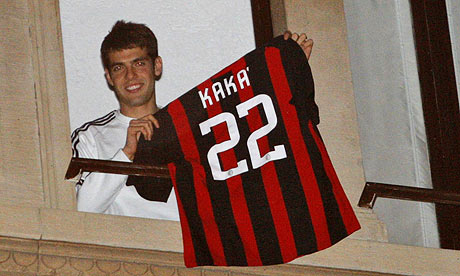
Inspired by Kaka

Milan's Brazilian superstar Kaka just rejected $700K per week in wages to stay at his club, turning down a transfer bid from Manchester City.  It is a truly inspiring move and I had to mention it.  And, it's not entirely unrelated to this blog's main themes.

AC-Milans-Kaka-shows-his--001

I try to focus my blog on value creation.  Wrongly, value creation is solely associated with transaction value.  However, time plays a tricky role in calculating the total value of any deal.  With his decision to stay at Milan,, I think Kaka's made the value maximizing choice for his career.