Nobody’s Tweeting

The header is not true.  However, Twitter usage is shaping up as significantly different compared to other social media.  According to Harvard Business Review:

Twitter's usage patterns are also very different from a typical
on-line social network. A typical Twitter user contributes very rarely.
Among Twitter users, the median number of lifetime tweets per user is one. This translates into over half of Twitter users tweeting less than once every 74 days.

twitter research 2.jpg

At the same time there is a small contingent of users who are very active. Specifically, the top 10% of prolific Twitter users accounted for over 90% of tweets. On a typical online social network, the top 10% of users account for 30% of all production.

This is very very intriguing.  First of all, Twitter is growing faster than any previous social media property, in terms of users.  Look at this graph from Compete:

Yet, the new users are not tweeting.  The median number of tweets is 1!  This is mindblowing.  To me, this makes Twitter look more like a TV broadcaster than a true social media property.  These 20+ million Twitter users are all following Shaq and Ashton Kutcher, and maybe that's it.

The only business disruption of Twitter so far seems to be its assault on RSS.  Even with Google Reader, RSS had never broken into the mainstream.  Maybe it never will.

UPDATE: Jeremy Liew's picked up the same point and also remembered that Nielsen reported on Twitter's poor retention track record.

Currently, more than 60 percent of U.S. Twitter users fail to return
the following month, or in other words, Twitter’s audience retention
rate, or the percentage of a given month’s users who come back the
following month, is currently about 40 percent. For most of the past 12
months, pre-Oprah, Twitter has languished below 30 percent retention.

I don't want to sound like a Twitter bear, because I am not.  I think Twitter's an example of the exciting opportunities the connectedness of the internet opens up.  However, we tend to group many things under social media these days and I suspect we're bundling models with very different characteristics.  I am trying to digest and understand the taxonomy and recognize the patterns.

Twitter Hyped by marketers?

A cool discussion emerged in the comments of Fabrice's latest post and I wanted to reflect it as a seperate topic here.

Fabrice proposed:

I am skeptical about all the hype around Twitter.

Comparing Facebook and Twitter, over 50% of Facebook’s 200 million
active users login every day. 60% of Twitter users stop using it after
a month. I personally find Facebook much more relevant to my personal
life – I like seeing pictures, relationship status changes, etc.

In the comments, I pointed to an earlier post with my similar feelings and Chris Abraham, who seems to have a very well-developed perspective on Twitter, countered with a long comment:

Twitter does everything right where Second Life failed. Second Life
was amazingly heavy, requiring lots of computer, lots of bandwidth, and
a commitment to client software; SecondLife
is a closed system, a walled city, completely invisible to serendipity
and coincidence; Second Life is greedy, pushing avarice and commerce;
Second Life is ephemeral and anti-textual, meaning that all of the work
and all of the energy one spent on Second Life invariably went away the
moment people stopped investing time and money into the platform. 
While there was a programming language, a scripting language, and lots
of room for creativity, Second Life was not nearly as agnostic and open
a platform as it could have been.

On the other hand, Twitter is open, has a fantastically generous API (Open API as opposed to a Closed API), Twitter is highly textual, highly “contagious,” and very much real time.

In many ways, the Twitter platform has become almost a fungible
INPUT / OUTPUT flow of data, like IP or like tap water, or like the
electrical mains — all the creativity and all of the development is
happening as a result of this relatively featureless and structureless
raw platform.

Everybody admits that the elegance of Facebook’s
interface does an amazing job of hand-holding the diverse levels of
technological prowess that Facebook users posses; however, Facebook
shares many things in common with Second Life: it is a walled-garden,
it is very cliquey and very hard to cross-pollenate, and finally —
Facebook works very hard at defining what the user experience is to the
best of its ability in a world where openness and open access can
oftentimes work for you instead of against you.

People who don’t get Twitter really have not spent enough time with
it.  There are tons of ways people can use Twitter.  Many people use
Twitter as an alternative to an RSS feed
news reader, following the Twitter feeds of news organizations and news
alerts, including links and so forth. Twitter doesn’t care how you use
it: passive reading or active conversation.

In fact, Twitter is such a neutral solution that you might very well
forget that you’re a member, which is why there might be a perception
that over 60% of all of the users who register never go back: Twitter
doesn’t want to be too much trouble.

Then the discussion between Chris and me veered over to the (to me) surpisingly high median age of Twitter users (31!, according to Pew), and what it meant for Twitter.  I think it's alarming and feel that it's an indication of the value of the social graph that is owned, at this pointi by Facebook.  Chris feels differently:

Well, “kids” don’t blog either. Kids won’t blog until they feel
empowered enough to start creating on their own accord or until they
find it useful — hell, “kids” might never ever take to Twitter, except
that they will want to engage with TMZ Staffers on Twitter
(@harveylevintmz @daxholt @ninaparkertmz @lmharris70 @carolynafenton
@frankvelardo) because there will be loads of kids who will get on
board to be able to stalk their favorite celebs and stars. But who
knows. Rockers and fans are still on MySpace and the “kids” have yet to
bail on Facebook (yet) so we’ll see what happens. It is very odd to see
how the median age for blogging and twittering is much older than you
would think: “the median age of a Twitter user is 31. In comparison,
the median age of a MySpace user is 27, Facebook user is 26 and
LinkedIn user is 40.7,” according to Pew, http://www.pewinternet.org/Reports/2009/Twitter-and-status-updating/Part-1/Section-3.aspx?r=1

Anyway, I think this is a very interesting issue.  It makes me think about the lack of microblogging interest in Turkey, especially given the enormous usage of SMS.  How does age play into it?  Do you need a social graph for presence communication?  Is Twitter being hyped by marketers, because it resembles a new, relatively unstructured, medium they can utilize for their clients/constituents?

What’s Wrong with Twitter that Kids won’t Use It?

Caroline McCarthy of CNET reports:

While 99 percent of 18- to 24-year-olds have profiles on social
networks, only 22 percent use Twitter, according to a new survey from
Pace University and the Participatory Media Network.

This is very interesting to me and I can not figure it out.  Is Twitter just a simple status updater for those who are not fully comfortable with Facebook?  Should it be a feature?

Turkey has 7th Largest and Most Engaged Online Audience in Europe

Anyone watching the Turkish internet market would not be surprised by this press release from comScore today. 

“The online population of Turkey far surpasses the rest of Europe in
terms of time spent and content consumed per person,” said Mike Read,
SVP and managing director, comScore Europe. “Much of this heavy
engagement is driven by usage of social networking and entertainment
media sites, which maintain users’ attention for extended periods of
time. There are certainly excellent digital marketing and advertising
opportunities in reaching these 17 million Internet users who are so
engaged with the medium.”

Turkey's sheer size is a factor here but old media's lack of innovation will continue to drive the young masses online, just as Facebook demonstrated.  Monetization of this massive level of engagement is not mature yet, but will follow.

This is an exciting day for Turkish internet.

PS:  Congratulations to our portfolio company, GittiGidiyor, for its placement in the Top 15 properties list.

Wisdom of Musical Crowds

This is really cool:

Bicycle Built For 2,000 is comprised of 2,088 voice recordings
collected via Amazon's Mechanical Turk web service. Workers were
prompted to listen to a short sound clip, then record themselves
imitating what they heard.

They should open source the audio tracks and see what others will make of it.

Is Twitter Threatening Facebook, or Vice Versa?

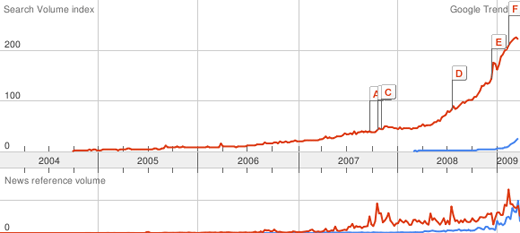
Anyone with a web presence can probably tell you that Twitter's growing extremely fast.  It's outpacing Facebook's growth in the same period, according to Nick O'Neill's analysis using Google Trends.  Here's the chart:

Twitter-facebook

However, I am not convinced that this is a fair comparison.

  • First of all, the early Facebook was not an open service. It required you to possess a dot-edu email address to register.  The comparison should be made to Twitter's college student user base.
  • Second, the price of admission to Facebook has always been considerable higher than Twitter.  A FB account without a full profile is less meaningful and severely limits the user experience.  Part of the cost of being a Facebook user is the profile completion effort.  Twitter does not have this barrier.
  • And finally, I attribute a part of Twitter's growth pace to the existing proliferation of social networks, including Facebook.  Facebook has been a catalyzer to Twitter.

 It's tempting to compare Twitter and Facebook.  However, I think it is as misplaced a comparison as the common Facebook / MySpace deathmatch.  Twitter is not a technology company.  It's a great feature, and I don't mean that dismissively, as I think you can build a great company with a feature.  Nevertheless, I'd be worried, if I ran Twitter, of its long term viability.  There will be only one owner of the social graph and the current favorite to win is Facebook.

Immigrant Entrepreneurship

My friend Aydin, in his new post, outlines his prescription for the ailing U.S. economy:  support for immigrant entrepreneurs.  He proposes:

Support the entrepreneurs, especially the immigrant ones. The stimulus
grants the government is handing out to different industries remains a
band-aid solution and basically just re-allocates existing resources.
Supporting the entrepreneurs, on the other hand, is likely to result in
new jobs, create *new* capital (ie new resources).

I have not researched the numbers on this but I strongly suspect that startups (not necessarily small lifestyle businesses, but high-impact entrepreneurial endeavors) are very efficient allocator of resources.  We felt this firsthand at SelectMinds, in the earlier stages, and created many jobs very rapidly as NYC climbed its way out of post-9/11 depression and the internet economy recovered from the dotcom crash.

Aydin also thinks startups founded by immigrants are critical to this phenomenon.  In that area, as he points out, there's quite a bit of impressive empirical evidence.  I have always believed that the U.S. is a net beneficiary of its progressive immigration policies (even though they can be improved).

I wonder if the same can be said about other countries.   I can not say I have seen examples of resourceful, enterprising endeavors by immigrants in Turkey.

Tweeting with Gods: Tweets as Haiku

Jeremy commented on my recent post and I thought I should elevate it to this blog's surface:

As
a poet and a writer, I have to agree with Joe on the idea of
constraints. Restrictions, parameters, forces of limitation: all of
these require us to do what we as humans do best: problem solve. Like
that lovely cliché, "necessity breeds invention": when confronted with
an obstacle, a constraint, we invent. And we could say the constraint
of 140 characters is as arbitrary as are the rules for writing Haiku.
Yet the latter remains popular, fruitful, and (when done well)
enlightening–after centuries. Does it replace the novel or the essay?
No, it cannot serve the same function. Likewise, no novel can approach
what Basho could in three short lines.

I suppose what I'm suggesting, really, is that like all hip content
these days, it's generated by the user, and it's the user who
determines quality. Just as I'm a better poet than I am a blogger or
tweeter, there'll be people who'll bring the best out of the 140
character form. And I think, what'll continue to define the life cycle
of the technology won't be whether there is portability or not, but
rather whether Twitter or its confederates (like ExecTweets) enhance
our ability to find those who, shall we say, Tweet with the Gods. Seems
like these days there are plenty of worthy practitioners in every
medium, but the media which survives does so on the basis that it's
deliverable to the right audiences, at the right time.

Who tweets with gods?  Do you have anyone you follow whose best is brought out by the 140-character limit?  Twitter haiku is fun and interesting.

In Need of Quotes and Easy-to-Swallow Bits of Wisdom

I was checking out ExecTweets, a new service by Federated Media and Microsoft that allows Twitter users to easily find and follow prominent business figures' TweetStreams.  Why would one want to do that?  When I look at who I follow on Twitter, it's mostly people I know and a few I don't but whose tweets I find either funny or interesting.  Twitter is very useful as a "status update" tool.  But I find efforts to say more through Twitter a bit forced.

Then I looked at sample tweets from the executives ExecTweets offers:

SteveCase Needless to say, an unsustainable trajectory. RT @boltyboy: US Health care costs 7% of GDP in 1970, 17% in 2009. http://tiny.pl/bnhc

zappos
"When a door of happiness closes, another opens. Often we look at the
closed door, we do not see the one that’s been opened." – Helen Keller

dwrasmus1
All times are times of uncertainty. We just notice it sometimes more
than others because something big shakes us from our complacency.

To me, it looks like the executive tweeters are broadcasting their thoughts and ideas in 140-character long bites.  Or, trying to…  Is this a usable format, or are we squeezing the ideas into the constraints of a soon-to-be obselete technology, the SMS?  Paul Graham broadcasts his ideas in thoughtful, edited essays.  Could I follow Paul Graham on twitter and understand his ideas?  I very much doubt it.

But quotes play an important role in communications.  They package ideas into more-easily-transportable packages.  The top quote sites enjoy (surprising to me) very high traffic numbers.

I wonder how the idea quality is effected by these new forms of packaging?