Sapiens

51xwPegEzlL._SX333_BO1,204,203,200_

If you are going to read one book this year, I’d recommend Sapiens, by Yuval Noah Harari.  I think it would make for a great vacation read, if you don’t mind non-fiction on the beach.

The book reminded me of another old favorite of mine, Jared Diamond’s Guns, Germs & Steel.  However, I found Sapiens to be more philosophical and funnier.  It also coincided with a period for me where I am trying to connect many dots at work, and provided good accompaniment to my mental process.

Enterprise Sales in Turkey

1-1252593298WHAn

If you are a technology startup targeting Turkish enterprises, you’d better bring your magnifying glass with you.  Here’s an unpopular fact:

Turkish enterprises are tiny!

Let’s take a closer look.  On the 2015 Turkish Fortune 500 list, #500 is a company called Metag.  Annual sales: 284m TL (about $100m).  By contrast, the #500 company in the US is Burlington Stores with $5.1b in sales, 50X the size of Metag.

Another way to look at this would be by absolute size.  If you determine that your target market is companies with >$1b in sales, your target list would have only 40 companies in Turkey.

The US economy is about 20X the size of the Turkish economy ($16tn vs $800b), so you get the picture. It’s not just the relative market size.   There are a lot more enterprises to sell to in developed markets, and each one is probably a more sophisticated buyer of your services, with larger budgets.

Big Numbers

finance-634901_960_720

The press loves big numbers.  Why? Because, the readers love big numbers.  Look at the headline below:

FireShot Capture 10 - Meet the Man Who D_ - https___mail.google.com_mail_u_0_#inbox_1552f8f3a973098a

There are two very large numbers, $5.5 billion and $62.5 billion, referring to two highly ambitious and rapidly growing companies, Lyft and Uber.  I am a fan of both startups.  However, they are both quite tiny in the global enterprise scale.

When you say an $X billion company, one understands that it’s a top-line revenue number.  Apple is a $230 billion company and Walmart is a $480 billion company, in general business speak.

I would also understand referring to these businesses by market cap.  It’s the company value of these businesses based on very liquid market information.  By this measure, Apple is a $450 billion company and Walmart is a $220 billion company.

You’ll notice that these two sets of numbers are almost exactly asymmetrical, so it’s always critical to clarify what one means when the phrase “$X billion company” is brought up.  But I find both to be acceptable and practical.

Then, there is the startup version, with which I have a problem.  I mentioned that both Lyft and Uber are quite tiny.  To be specific, lats year Lyft had a rumored ~$100 million in revenues.  Uber, which is larger, had its revenues estimated at $1.5b billion.  Both numbers are very small compared to those of Apple and Walmart.  Bu this is not stopping the press to refer to them as $5.5 billion and $62.5 billion companies.

Why? VC round valuations.  These two companies, have been valued, in private rounds, details of which are not announced, at the larger numbers mentioned above.  So, all of a sudden, you find that you can get away with calling Uber a $62.5 billion company. And, jaws drop.  Your readers are awed. Links get clicked on.  Young entrepreneurs pull out their calculators and start multiplying their own metrics with the multiples they can extrapolate from Lyft and Uber numbers.  And, expectations rise, appetites get whetted…  And, bubbles form.

Because, the press loves big numbers.


The Disconnect in Online Advertising

Online ads suck, but it’s the main driver of today’s internet.

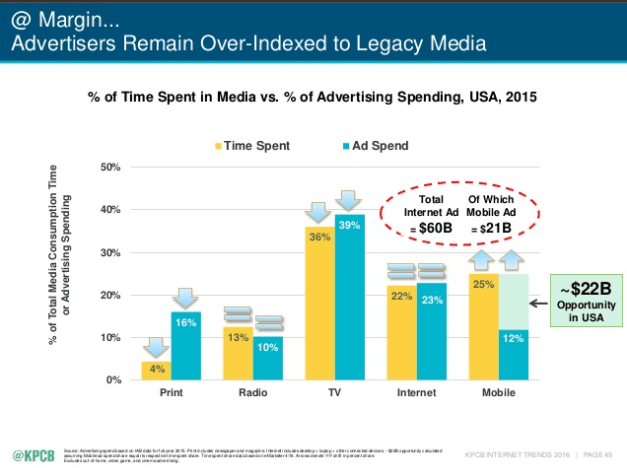
If you did not already know that, a great place to look for confirmation is Mary Meeker’s 213 slide Internet Trends deck, in which, slides 41 thru 110 are dedicated to the examination of how different forms of online ads are growing and that it’s accelerating.  It’s depressing really.  And the money slide is this one:

FireShot Capture 6 - 2016 Internet Trends Report_ - http___www.slideshare.net_kleinerpe

In summary, it will get worse before it gets better.

This is confusing to me.  Because, on the other side of the internet coin is that high quality, frictionless offerings are winning on the internet.  Look at the most successful apps.  Booking.com is eating the lunch of other hotel OTAs, primarily because it works so well.  Uber is a lesson in on-demand UX.  Airbnb’s user experience has helped its massive global network effect, in taking the big lead it has in global marketshare.

Ads, on the other hand, are pulling in the opposite direction.  1010!, a great game, is pissing me off with 5-second video after video, trying to get me to accidentally click on an app install.  And, I am not alone. Back to Meeker’s deck:

Millenials:

81% = Mute Video Ads
62% = Annoyed with / Put Off by Brand Forcing Pre-Roll Viewing
93% = Consider Using Ad Blocking Software

Here’s the slide:

FireShot Capture 7 - 2016 Internet Trends — Kleiner Perkins C_ - http___www.kpcb.com_internet-trends

This disconnect between how fast online advertising is growing while remaining a nuisance for internet users has made it tough for us to build strong investment theses for ad driven business models.  It’s also probably why we get turned on by technology that looks to improve the efficacy in the sector.

The Second Time Around

I just answered an interesting question on Quora.  I think it may be interesting to readers of this blog, as well, so I’ll copy it here, too.

Question:
If a VC did intense due diligence on my seed round but ultimately passed, should that impact my decision to consider him for a Series A?

Answer:
Our experience is that by the time we decide to invest in a startup, we have usually interacted with them over a period of time, sometimes at different milestones. There have been instances, where we’d passed at an early point and then decided to invest in a subsequent round.

We pass for many different reasons. Sometimes it’s about fundamentals – the chemistry with the team is just not there for us, or maybe the market size is too small. If we are passing for fundamental reasons, it’s unlikely that we’d ever look to invest later in that company.

However, many times, the pass decision is because we’re just not “quite there” with our investment thesis. In these situations, we try to make sure that the team is getting some value out of their interaction with us. And, we encourage them to stay in touch, come to us with questions, or if there are ways we can be helpful, we try to bring those to bear. Our hope is that we stay close to the company, see if we can get more comfortable with their business along the way – perhaps observe the team as they overcome their challenges, and if at any point along the way, we can come up with an investment model we can feel comfortable with, then make an offer for an investment.

From the company’s standpoint, the decision whether to accept that offer should be a rational one.

They would also have had the opportunity to get to know us along the way. They may have seen us demonstrate the characteristics they would want to see in their investors: whether we “get” them, whether we are smart, hard-working and ethical. Ultimately, the founders’ goal should be to maximize the probability of success for their startup.

In short, the answer to the question should not feel difficult at the point where an offer is on the table from the VC.


 

ChubbyBrain Ventures

chubbybrain-ventures.gif

Startup data provider CB Insights had an April Fool’s Day blog post on how they are launching a new VC fund.  The announcement post was quite amusing, full of over-the-top claims on their plans and strategy.

Yesterday, they provided a clarification in their daily newsletter that this was a joke, since they had received messages from LPs asking for their PPM, pitch decks form companies looking for VC funding, and resumes from people looking for a VC job.

Not very surprising.  Our industry has become very buzz-word driven in how we talk about our strategy.  If you look at marketing language from VC funds, you’ll find a lot of throw-away language and realize that it’s difficult to tell one firm from the other.

Let’s hope that some real VC funds don’t eventually turn into jokes.


The Pendulum on Turkey

mars

In my conversations with non-Turkish friends lately, the dominant topic has been what’s going on in Turkey.  This is of course fuelled by the stream of news on the country over the last three years, starting with the Gezi protests: questions on the stability of the government, the sliding lira, the refugees from Syria, the war at our doorstep, the crisis with Russia, the back to back elections, etc.

For us, the most easily-observable impact has been the disappearance of western VC interest from the Turkish tech market.  Attending the annual Startup Turkey event in February, we were surprised at how it was only the local or regional VCs who showed up.  By contrast, just two years ago, the same event had attracted names from a long list of firms from Silicon Valley, New York, London, Berlin and Paris.  Even though many were there on early scouting missions, the sentiment was that Turkey may be “Europe’s China” when it came to tech opportunities.

The truth is it never was.

However, neither is it “the next Syria”, as the sentiment may be today.  The pendulum always swings too far, in both directions.

A great example for this is the recent exit by the local PE firm Actera of its stake in Mars Cinemas at an EV of $800 million.  About a year after the acquisition of YemekSepeti by Delivery Hero for $589 milllion, it comes as a reminder of the size and scope of the Turkish economy, and the fact that you can build large, healthy businesses serving the needs of Turkish consumers.

As investors, it’s critical for us to keep our eyes on data and metrics, and resist getting swayed by fickle public opinion.  That’s how you build value.

Choice in the Age of Abundance

lots

It used to be that when you wanted to stay at a hotel in a city, you went to a few sets of trusted brands that signaled what you were looking for.  If what you needed was a clean, basic, business hotel, perhaps Holiday Inn would reliably provide you with that.  If you wanted luxury, you’d seek out the Four Seasons in the same city.

In the connected world, the search model changed.  For hotels, you go to Booking.com, which brings you a vast set options.  You try filtering, but the taxonomy is difficult and filters fall short.  If you search for a 5-star hotel room in NYC for February 14, you get 44 available rooms, ranging from $194 to $800.  Certainly those are not apples to apples.  The experience on Amazon, unless you know exactly what you are looking for, is the same.  Our search problem is a bigger one in the age of abundance.

That’s where the trusted brands and curators come back into the picture.  Just like twenty years ago, I find myself looking at familiar chains on Booking.com, and the recommendations on the Michelin guides, for my choices.

I suspect AI will come to the rescue here.  But I have yet to see strong working examples.

Proven Models

I just read the article “The Beginning of the End of ‘Gimmick Commerce’?” by Jason Del Rey and realized that it overlaps with a topic I have been thinking about for some time.

One of the themes we have been investing in, both as a fund and as an angel investor, has been backing strong teams, going after large opportunities in emerging markets, utilizing proven business models that have worked elsewhere.  This is not very original.  Many investors have been very successful following the same model, including Tiger Global and Rocket Internet.

Our investments in this theme include GittiGidiyor (similar to eBay), Trendyol (VentePrivee and Asos), and Vivense (Wayfair).

What I have learned, though, is that it’s very difficult to determine when a certain model is truly “proven”.  In 2010, many thought that the Groupon business model was viable.  After all, Groupon had grown to billions in revenues and pulled off a successful IPO.  But now we see that the model as conceived back then proved to be not quite sustainable.  Andrew Mason has a good blog post about what went wrong.  Today Grupanya has evolved from a daily deal company to a local commerce marketplace.

Other companies, including Jason’s examples of Gilt, Zulily and One Kings Lane have faltered.  He thinks the reason is gimmicky sales pitches.  I suspect it is the attempt to scale these businesses before the basic business models could prove to be sustainable in the long term.

Technology Hazards

pow

We usually think about technologic developments making us more vulnerable to threats because of blind spots they may create.  As a new ATM user, you had to make sure your PIN number does not get compromised.  If you are a Tesla driver, you need to think about securing your car so that it does not get hacked by an intruder.  This is well understood.

There is another type of hazard that is caused by technology that now allows you to access areas that you previously were not able to venture into.  One needs to be cautious about these, because they may be less visible.

The reason I am thinking of this is that I am going skiing this weekend and just received the news of two large avalanches in the area.  The number of avalanche-related skiing accidents is rising and this is generally attributed to improvements in ski technology that makes it easier for inexperienced skiers to venture into backcountry terrain that previously required a higher level of skiing ability and experience.

To end on a positive note, it’s been dumping in the French Alps and there will be excellent powder.  Enjoy it carefully please.